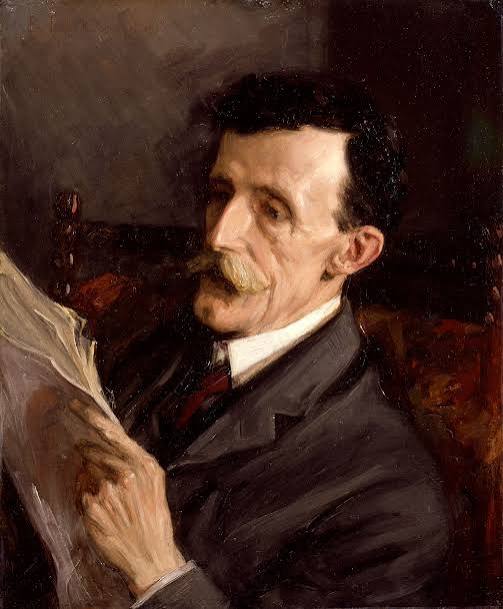
 Frederic William Maitland (May 28, 1850 – December 19, 1906) was an English legal scholar and historian, widely regarded as the modern father of English legal history.
Queer Places:
Eton College, Windsor SL4 6DW, UK
University of Cambridge, 4 Mill Ln, Cambridge CB2 1RZ
Cementerio inglés, C. Marconi, 13, 35015 Las Palmas de Gran Canaria, Las Palmas, Spain
Frederic William Maitland (May 28, 1850 – December 19, 1906) was an English legal scholar and historian, widely regarded as the modern father of English legal history.
Born in London to a distinguished intellectual family, Maitland was educated at Eton College and Trinity College, Cambridge. After initially studying mathematics, he switched to the Moral Sciences Tripos under the mentorship of philosopher Henry Sidgwick, graduating with first-class honors in 1872.
He was called to the bar at Lincoln's Inn in 1876. Finding practice at the bar less appealing than academic research, he returned to Cambridge in 1884 as Reader in English Law and was appointed Downing Professor of the Laws of England in 1888.
In 1887, Maitland co-founded the Selden Society to encourage the study and publication of historic English legal texts. His seminal work, The History of English Law Before the Time of Edward I (1895), co-authored with Sir Frederick Pollock, remains a classic in historiography.
In 1886, he married Florence Henrietta Fisher, with whom he had two daughters, Ermengard and Fredegond. Struggling with tuberculosis in his later years, he wintered in the Canary Islands, where he died in Las Palmas in December 1906.
Maitland was elected to the Cambridge Apostles, following in the footsteps of his father, John Gorham Maitland.
Joining during his undergraduate years at Trinity College, Maitland was part of an elite, secret intellectual circle alongside contemporaries like Frederick Pollock, Arthur Balfour, and his mentor Henry Sidgwick. He was active in discussions on philosophy, ethics, and social reform and also served as secretary and president of the Cambridge Union.
The Apostles met weekly to debate philosophical and societal questions in an atmosphere that encouraged radical candor and challenging Victorian moral dogmas.
There is no historical evidence suggesting that Frederic William Maitland identified as homosexual or bisexual in his personal life. However, his connection to LGBTQ history exists through his social and intellectual circles:
The Cambridge Apostles hold a significant place in LGBTQ cultural history. In the late 19th and early 20th centuries, the society served as a homosocial sanctuary where members openly debated romantic intimacy, Platonic love, and homoeroticism in defiance of strict Victorian norms.
While Maitland was part of a generation dominated by figures like Henry Sidgwick and Oscar Browning, the Apostles later elected prominent gay and bisexual intellectuals, including Goldsworthy Lowes Dickinson, E.M. Forster, John Maynard Keynes, Lytton Strachey, and Ludwig Wittgenstein.
Maitland’s extended family and social ties closely overlapped with the Bloomsbury Group, a circle famous for its non-traditional relationships and open attitudes toward homosexuality and bisexuality:
Maitland was a close personal friend and official biographer of Sir Leslie Stephen (father of Virginia Woolf and Vanessa Bell).
His wife, Florence Henrietta Fisher, belonged to the Fisher family, whose members were closely linked to the Stephen family and the broader Bloomsbury set. Following Maitland's death, Florence married Sir Francis Darwin (son of Charles Darwin).
References:
Support this project
This website is a passion project researched, developed, and funded entirely by me. If you find the content valuable and would like to help support the ongoing research and hosting costs, any contribution is deeply appreciated.
Thank you for keeping this independent resource alive!
My books on Amazon: Elisa Rolle's books